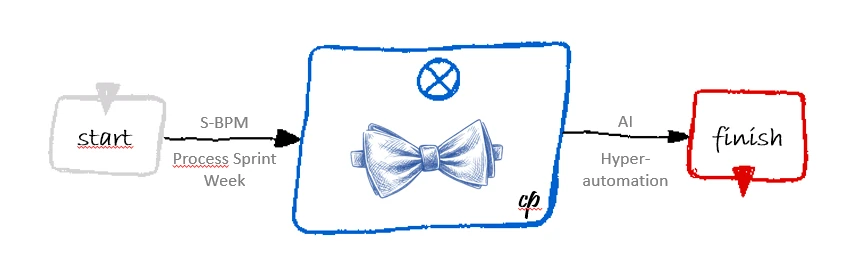

S-BPM (Subject-oriented Business Process Management) is a process-centric approach that puts acting roles (subjects), their actions, and message exchange at the center. According to core principles, processes are modeled closer to natural language: Subject – Predicate – Object.
Core Competence
S-BPM: The Operating System of the Future.
Subject-oriented Business Process Management puts the acting subject at the center. The intuitive Subject–Predicate–Object logic is the ideal language for AI agents.
Subject – Predicate – Object
The natural grammar of every business process. Simple. Precise. Machine-readable.
Subject
Who acts? The person (or AI agent) is at the center—not the diagram.
Predicate
What does the subject do? Send, receive, process—the core grammar of every process.
Object
What is affected by the action? Documents, messages, data—clearly defined.
Core Format
Process Sprint Week
Based on the Design Sprint. Sharply focused on process validation. 0–0 days. One outcome.
Mo
Problem Framing
Define the challenge with precision.
Di
Process Mapping
Capture the current state with S-BPM.
Mi
Target Design
Design the optimized process.
Do
Prototype
Build a working process flow.
Fr
Validation
Test, refine, and release.
Future
Hyperautomation & AI Integration
S-BPM provides the foundation on which AI agents can operate reliably. Once the subject is clearly defined, an agent can take over—seamlessly, traceably, and at scale.
- AI agents built on S-BPM
- No-/Low-code automation
- Workflow orchestration
- AI-powered process validation
Fail Fast.
A broken prototype on Tuesday is better than a perfect concept that never sees daylight. My approach: validate, don’t philosophize.
Plan Your SprintFAQ
Frequently Asked Questions about S-BPM
Concise answers to key questions about subject orientation, PASS, and practical implementation.
Traditional phase- and control-flow-oriented models often describe processes hierarchically. S-BPM instead focuses on decentralized interactions between subjects. This reduces complexity in variants, loops, and multiple inputs/outputs, and improves clarity for business teams.
S-BPM is especially suitable for organizations with complex collaboration across teams, roles, or systems—for example in Industry 4.0 and service-oriented environments. It is ideal for companies that want processes to be both business-readable and technically executable.
S-BPM enables clear responsibility boundaries, explicit interactions, and higher modeling quality. In the referenced research, it achieved significantly shorter modeling time compared with BPMN (around 40% faster in the observed groups).
In practice, you first identify the involved subjects (e.g., customer, procurement, production). Then you model inputs, outputs, and message flows between these subjects. Each activity is assigned to a subject, and interactions are explicitly defined to ensure traceable control.
PASS (Parallel Activity Specification Schema) is a formal modeling language for subject-oriented process descriptions. It uses Subject Interaction Diagrams (SID) for communication and Subject Behavior Diagrams (SBD) for internal subject behavior.
Yes. Executability is a core advantage: models can be validated and executed using formal concepts (including Abstract State Machines). This shortens the path from process description to implementation.
AI agents require clear roles, responsibilities, and message logic. S-BPM provides exactly that structure. When subjects, actions, and data objects are well defined, automations and agentic workflows become more robust and auditable.

Scientific Foundation & Network
Member of i2pm – Institute of Innovative Process Management
i2pm was founded by the developers of S-BPM and is the leading scientific network for innovative process management methods. As a member since 2010, I bring more than 14 years of experience in subject-oriented process management.
Put S-BPM into Practice
Talk to an Expert
In 30 minutes, we clarify how Subject-oriented Business Process Management and AI can work together in your specific process.
Get Started Now